WORLD BREASTFEEDING WEEK

Theme: Breastfeeding for a Sustainable Start in Life: Strengthen What Works

Every year , from the 1st to the 7th of August, the world comes together to observe World
Breastfeeding Week. This global campaign is coordinated by the World Alliance for Breastfeeding
Action (WABA) in collaboration with the World Health Organization (WHO), UNICEF ,
governments, healthcare professionals, and various organizations worldwide. The aim is to promote,
protect, and support breastfeeding while raising awareness of its immense benefits to infants,
mothers, families, and society as a whole.
Although breastfeeding is one of the most natural processes, many mothers face challenges due to
inadequate support, misinformation, workplace limitations, cultural misconceptions, and lack of
access to proper healthcare guidance. World Breastfeeding Week serves as an opportunity to
educate communities, advocate for breastfeeding-friendly environments, and encourage everyone
to support mothers throughout their breastfeeding journey.
Importance of Breastfeeding
Breastfeeding is one of the most effective ways of ensuring child survival, growth, and
development. It provides numerous health, nutritional, emotional, and economic benefits.
Benefits to the Baby
Breast milk is often referred to as the baby’s first vaccine because it contains antibodies that protect
infants against infections and diseases. Babies who are breastfed are less likely to suffer from:
* Diarrhoeal diseases
* Pneumonia
* Ear infections
* Respiratory tract infections.
* Allergies
* Obesity later in life
* Type 1 and Type 2 diabetes
* Childhood leukemia
* Sudden Infant Death Syndrome (SIDS)
Breastfeeding also supports proper brain development and has been associated with improved
cognitive performance, learning ability, and higher intelligence scores. In addition, the close
physical contact between mother and baby during breastfeeding promotes emotional security,
bonding, and psychological well-being.
Benefits to the Mother
Breastfeeding is equally beneficial to mothers. It stimulates the release of oxytocin, which helps the
uterus contract after childbirth, reducing postpartum bleeding and promoting faster recovery.
Long-term benefits include a reduced risk of:
* Breast cancer
* Ovarian cancer
* Type 2 diabetes
* High blood pressure
* Cardiovascular diseases
* Osteoporosis later in life
Breastfeeding also delays the return of fertility through the Lactational Amenorrhea Method
(LAM), although this should not be relied upon as the sole method of contraception unless specific
conditions are met.
Furthermore, breastfeeding strengthens the emotional bond between mother and child and
contributes positively to maternal mental health by promoting confidence and reducing stress.
Conclusion
World Breastfeeding Week reminds us that breastfeeding is one of the simplest, safest, and most
effective ways to improve child survival and maternal health. It is an investment in healthier
families, stronger communities, and a more sustainable future.
Every mother deserves accurate information, compassionate support, and an enabling environment
that empowers her to breastfeed successfully. By working together as healthcare professionals,
policymakers, employers, families, and community members, we can ensure that every child
receives the healthiest possible start in life.
Breastfeeding is more than nourishment—it is a gift of life, love, protection, and hope for future
generations.
References (AP A 7th Edition)
1. World Health Organization (WHO). Breastfeeding . (2024). On World Breastfeeding Week,
UNICEF and WHO call for equal access to breastfeeding support.
2. World Health Organization (WHO). Key Messages for World Breastfeeding Week . (2024).
World Breastfeeding Week: Key messages.
3. UNICEF . World Breastfeeding Week . (2024). This World Breastfeeding Week, UNICEF
and WHO call for equal access to breastfeeding support.
4. UNICEF Nigeria . (2024). On World Breastfeeding Week, UNICEF and WHO call for equal
access to breastfeeding support.
5. Kliegman, R. M., et al. (2020). Nelson T extbook of Pediatrics (21st ed.). Elsevier .
6. Murray, P . R., Rosenthal, K. S., & Pfaller , M. A. (2021). Medical Microbiology (9th ed.). Elsevier .
7. World Alliance for Breastfeeding Action (WABA). (2024). World Breastfeeding Week Campaign


written by: Ibeneme Precious

EFFECT OF AZITHROMYCIN ON PLASMODIUM FALCIPARUM

Azithromycin is a macrolide antibiotic that is primarily used to treat bacterial infections. Although it is not a standard antimalarial drug, it possesses antiplasmodial activity against Plasmodium falciparum, the parasite responsible for the most severe form of human malaria.

MECHANISM OF ACTION

Azithromycin targets the apicoplast, a plastid-like organelle that is essential for the survival of the malaria parasite. It binds to the 50-S ribosomal sub-unit within the apicoplast, inhibiting protein synthesis. This disruption prevents the parasite from producing proteins required for its growth, replication, and survival.

KEY EFFECTS ON PLASMODIUM FALCIPARUM

Inhibits protein synthesis within the parasite’s apicoplast.
Suppresses parasite growth and multiplication.
Produces a delayed-death effect, meaning parasites often complete the current life cycle but fail to survive or reproduce in subsequent cycles.
Reduces parasite density (parasitemia) over time.
May decrease malaria transmission by lowering the number of circulating parasites.

CLINICAL SIGNIFICANCE

Despite its antimalarial activity, azithromycin acts more slowly than conventional antimalarial drugs. Therefore:
It is not recommended as monotherapy for uncomplicated or severe P. falciparum malaria.
It has been evaluated in combination with other antimalarial agents, such as artesunate or quinine, to improve treatment outcomes.
It may be considered in selected situations, such as during pregnancy when some antimalarial drugs are unsuitable, but only under medical supervision.

ADVANTAGES

1. Good safety profile and generally well tolerated.

2. Can provide dual benefits by treating certain bacterial co-infections while contributing to malaria treatment when used in combination.

3. Has a lower risk of serious adverse effects compared with some alternative medications.

LIMITATIONS

1. Slow onset of antimalarial activity.

2. Less effective than artemisinin-based combination therapies (ACTs).

3. Should not replace recommended first-line antimalarial treatments.
Widespread use may contribute to antibiotic resistance.

CONCLUSION

Azithromycin exhibits antimalarial activity against Plasmodium falciparum by inhibiting protein synthesis in the parasite’s apicoplast, resulting in impaired growth and a characteristic delayed-death effect. However, because of its slow action and lower efficacy, it is not recommended as a standalone treatment. Its role is mainly as an adjunct to established antimalarial drugs in specific clinical circumstances.

Diphtheria

Diphtheria is a dangerous bacterial infection that damages the mucous membranes in the nose and throat. Diphtheria can by avoided by the use of vaccines even through it is contagious from person to person.

WHAT CAUSES DIPHTHERIA?

Diphtheria is caused by a kind of bacteria called CORYNEBACTERUM DIPHTHERIAE. The disease is often passed from person to person or through touch with objects that have the bacteria on them, like a cup or used tissue. If you are in close proximity to someone who has diphtheria and they cough, sneeze or blow their nose, you could also contract the disease.
An infected person can potentially spread the bacterial infection for up to six weeks after the initial infection, even if they dont exhibit any diphtheria symptoms or signs.
The bacteria typically infect your throat and nose. The bacteria release harmful compounds known as toxins after you are infected. The poisons circulate throughout your bloodstream and frequently result in the formation of a thick, grey coating in the following bodily parts:
1) Throat.
2) Tongue.
3) Nose.
4) Airway.
These toxins can occasionally harm other organs including the heart, brain and kidneys. Complications that could be fatal can result from this, including:
1) Myocarditis ( inflammation of the heart).
2) Renal failure (kidney failure).
3) Muscular paralysis.

WHAT ARE RISK FACTORS.
Diphtheria is fairly common in developing countries where immunization rates are low. In these countries, children under age 5 and people over age 60 are particularly at risk of getting diphtheria. People are also at an increased risk of contracting diphtheria if they:
– aren`t up to date on their vaccinations.
– visit a country that doesn`t provide immunizations.
-live in unclean or crowded environment.
-have an immune system disorder such as AIDS.

WHAT ARE THE SYMPTOMS OF DIPHTHERIA?
Diphtheria symptoms frequently show up two to five days after the infection. While some people have moderate symptoms similar to the common cold, others don`t feel any symptoms similar at all.
A thick grey coating on the tonsils and throat is the most obvious and typical sign of diphtheria other typical symptoms include:
1) Fever.
2) Chills.
3) Rapid breathing.
4) Cough.
5) Sore Throat.
6) General fatigue.
7) Slurred speech.
8) Changes in vision.
9) Signs of shock.
HOW CAN DIPHTHERIA BE DIAGNOSED?
A diagnosis will be made by your doctor based on your symptoms and the results of a lab test. They obtain a sample from your sore or the back of your throat using a swab. The swab is subsequently sent to analysis and diagnosis.

HOW IS DIPHTHERIA TREATED?
Treatment for diphtheria starts immediately often even before the results of the lab tests are confirmed. To prevent organ damage your health care provider will administer diphtheria antitoxin. To treat infections, they`ll recommend antibiotics, usually penicillin or erythromycin.
To stop the spread of the disease, diphtheria patients are segregated from the general population. After taking antibiotics for around 48 hours, an infected person is no longer contagious. Tests will be be repeated to confirm that the bacteria are eliminated when therapy is finished. You will receive a vaccine to stop further illnesses after the bacteria are eliminated when therapy is finished. You will receive a vaccine to stop further illnesses after the bacteria are eliminated.

HOW IS DIPHTHERIA PREVENTED?
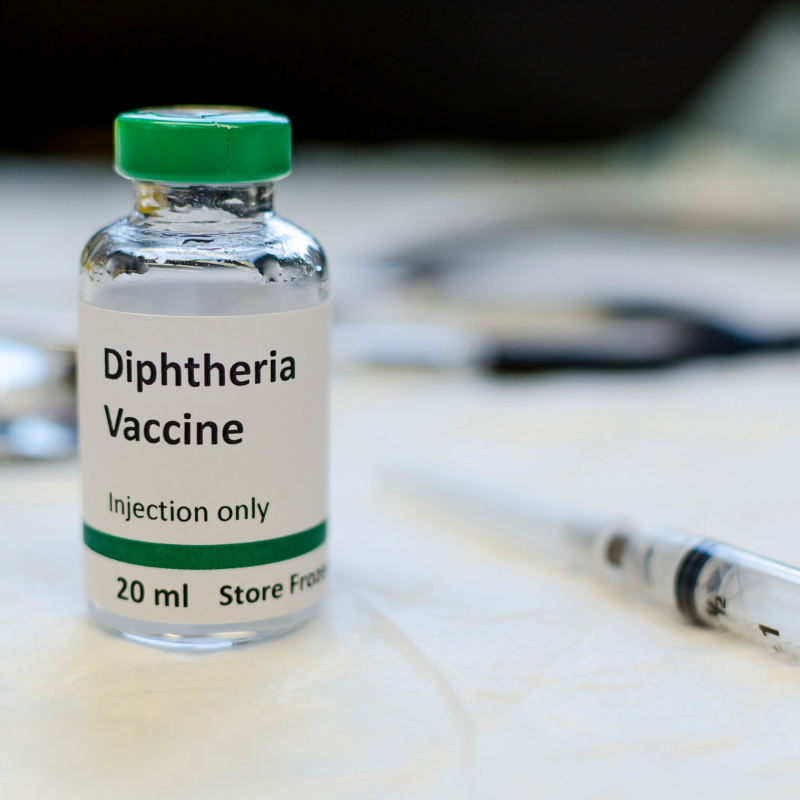
Antibiotics and vaccines can be used to prevent diphtheria. The vaccine for diphtheria is called DTap. It`s often administered in a single dose alongside the pertussis and tetanus vaccines. It takes five doses to fully protect against the DTap virus. Children receive it at the following ages trusted source:
1) 2 months.
2) 4 months.
3) 6 months.
4) 15-18 months.
5) 6 months.

A child may in extremely rare circumstances, develop an allergy to the immunization. This may cause lives or seizures that will eventually go away.
Since vaccines only remain effective for 10 years, your child will remain another vaccination around the age 12. it is advised that adults receive a single dose of a booster vaccine that include diphtheria, tetanus and pertussis. You will thereafter receive the tetanus-diphtheria(TD) vaccine every 10 years. By following these instructions, you or your child may be shielded from future diphtheria.

Add to cart